







LWS International Curriculum | Faculty Interview: An Inside Look at the A-Level Mathematics Course
A diverse school, brimming with vitality and youth!
LWS offers an AP + A-Level curriculum system, delivering diversified teaching, more choices of direction, and a wider range of destination countries for further study!
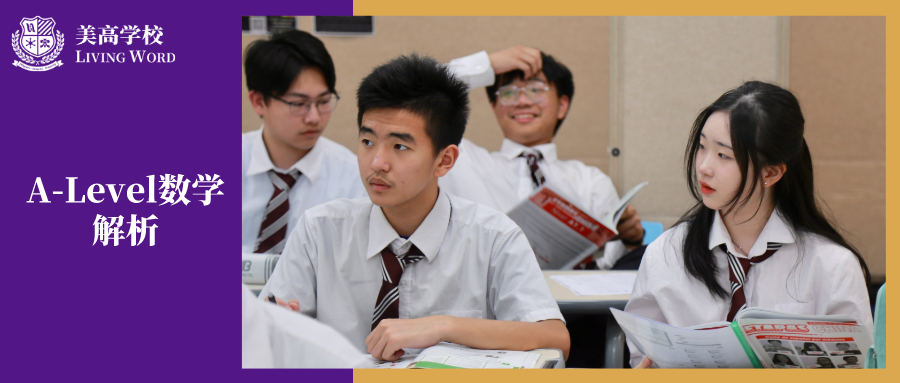
In the last issue, we introduced the A-Level English course. In this issue, let us explore the LWS A-Level Mathematics course — stay tuned!
A-Level Mathematics
Mathematics has always been a popular subject across majors and international curricula, but it is also one of the more challenging ones. Whether you plan to study business or science at university, A-Level Mathematics is a required subject. So what exactly does A-Level Mathematics involve?
Rebecca
University of Melbourne
4 years of international education and teaching experience
Extensive IG and A-Level teaching experience
The following content comes from Teacher Rebecca’s
interview, compiled as follows:
Overview of the A-Level Mathematics Course
A-Level Mathematics can be divided into Mathematics (Math) and Further Mathematics (Further Math) — two A-Level subjects.Both courses can be used as A-Level subjects when applying to university.
Mathematics is compulsory, while Further Mathematics is elective. Students with weaker foundations are advised to complete Mathematics over two years; engineering-track students may take Further Mathematics in the third year!
Key Points and Combinations of Each CAIE A-Level Mathematics Paper
CIE’s A-Level Mathematics includes 6 components, i.e., 6 papers (of which 4 are taken)
Paper 1: Pure Mathematics 1
Exam topics include quadratic equations, coordinate geometry, circles, trigonometry, sequences, and calculus.
P1 is the foundation of the entire A-Level Mathematics and Further Mathematics.
Paper 2: Pure Mathematics 2
Exam content includes algebra, numerical solutions of equations, trigonometric functions, advanced calculus, and algebraic and exponential functions.
The content of P2 is entirely covered by P3, so students generally do not take P2.
Paper 3: Pure Mathematics 3
Exam content includes algebra, logarithmic and exponential functions, trigonometry, calculus, numerical solutions of equations, and complex numbers.
P3 expands upon and raises the difficulty of the knowledge from P1 and P2; its overall difficulty is the highest of all modules.
Paper 4: Mechanics
It covers forces and equilibrium, rectilinear motion, momentum, Newton’s (three) laws of motion, and energy, work, and power — involving many physics concepts.
Mechanics is one of the easier modules: the calculations are not complex, and the mechanics and kinematics models are fairly limited. Compared with P3 and S1, it is easier to score well.
Paper 5: Probability & Statistics 1
Probability & Statistics 1 covers statistics-related knowledge, including data representation, permutations and combina"
照片描述
Media Contact
简介
地址
021-51093665/span>